I have been sitting with Calum Chace’s Artificial Intelligence and the Two Singularities for a while now, and it is one of those books that keeps surfacing in my thinking whenever someone brings up AI and immediately jumps to Skynet. Chace’s argument is more interesting, and useful.
He proposes that there isn’t only one singularity — but two. A technological singularity, where machines surpass human intelligence and the whole trajectory of the species bends around that fact. And an economic singularity, where AI’s deployment across every industry produces mass unemployment long before anything resembling super-intelligence shows up. Chace’s point, and the one I keep coming back to, is that the economic version is the more likely one — and the one few are prepared for.
Narrow AI vs. General AI
Chace draws a line between artificial narrow intelligence (ANI) — the type of AI that’s already prevalent, performing specific tasks — and artificial general intelligence (AGI), which would involve something closer to consciousness and subjective experience. We are not near AGI yet. What we regularly incorporate is ANI, which reorganizes how we work.
That distinction reframes the potential anxiety. People picture Terminator. What they should be picturing is in fact, call centres, e-commerce, and manufacturing automating due to faster speed, cheaper labour, and more consistent performance — no sentience required.
The “iceberg”
One of the ideas from the book that’s stuck with me is what Chace calls the “iceberg” phenomenon. A junior lawyer appears to be on thin ice — his entry-level job is exactly the kind of task AI can now complete. But he is actually standing on an iceberg where a mass of newly available work still stands beneath him (at least for now). While automation may be progressively replacing these jobs, too the transition is slower and stranger than the panic may suggest, and the displacement takes place from the bottom up.
What’s left for us
Chace lists lower-income service work, retail, manual labour — and, more provocatively, lawyers and journalists — as sectors already being reshaped. Not eliminated. Reshaped.
Chace offers seven factors that keep humans working even as AI penetrate the labour market:
Partnership with AI rather than replacement by it
Lower wages, as a trade-off for staying employed
Work that requires empathy
Goods and services rebranded as “artisanal” — made by human hands
Entrepreneurship
The arts
Categories of work that don’t exist yet
Last one is honest because it is an admission that few knows what might be coming, including Chace. He quotes Kevin Kelly of Wired — “machines are for answers; humans are for questions” — as a kind of consolation. AI still doesn’t have common sense. It can’t ask the questions that streamline the problem. That belongs to us, at least for now.
He also draws a line between artistry and creativity. AI can produce “art.” But the human artist expresses something of personal significance, something that derived from lived experience. Whether that distinction holds up — whether audiences will care about the difference, might be a separate question. But Chace’s claim is that it does matter, and that it will keep mattering economically, even as the technical gap between AI output and that of human closes.
2035, and the Economy Nobody’s Designed Yet
Chace marks 2035 as a transitional year, when AI plays a much bigger role across transportation, manufacturing, retail, construction, health care, finance, education, and government — and unemployment climbs as a result. His response to that isn’t doom rather, a call to design “a new type of economy which we have not yet designed.” He suggests a few shapes it could take: a “Star Trek” economy of energy abundance, a version of socialism built around universal income, or collective ownership running on blockchain infrastructure that requires no governments. What his warning concerns is sequencing — if technological unemployment “arrives in a rush,” we get dystopia. But if we see it coming and plan for it, we are ahead.
Where my view diverges
Here’s where I depart from his argument slightly. I appreciate the optimism, and I think his diagnosis is largely right — the economic singularity is more plausible and more pressing than the technological one. I don’t think that’s controversial among workers in the field. But I have a harder time imagining the leap from “capitalism as it currently functions” to any of the alternatives he sketches. That’s not just a shift in policy. It’s a shift in mindset, and it requires governmental will that doesn’t currently exist anywhere I can point to.
Chace seems to think mass unemployment might be the forcing function — that people won’t embrace a shared or redesigned economy until they’re pushed into it. And we actually got a real-world test of that idea during the pandemic. Mass disruption to work, real-time experimentation with income support, entire sectors reorganizing overnight. Did any of that shift the underlying capitalist mindset? I am not sure. The disruption happened. The reimagining didn’t follow. So I’m left wondering whether Chace’s forcing-function theory actually holds, or whether we’re capable of absorbing enormous economic shocks without ever questioning the system that produced them.
Source: Chace, C. (2018). Artificial Intelligence and the two singularities. CRC Press, an imprint of the Taylor & Francis Group
Every time a new AI model ships, someone declares that minds are finally leaving bodies behind — that consciousness is just information, and information can run on any substrate. While the idea seems advance when supported by technology, it is according to literary theorist N. Katherine Hayles, a very old story that we keep telling ourselves for reasons that have less to do with computers than with power.
Hayles made this argument at length in How We Became Posthuman: Virtual Bodies in Cybernetics, Literature, and Informatics (University of Chicago Press), and even though the book is now a quarter-century old, its central move is worth revisiting — not as history, but as a working diagnostic for how we are still talking about AI, embodiment, and the self. I want to walk through that argument here, then check it against where her thinking has gone since, because a theorist who stopped updating her own model would be a strange thesis to admire.
Three waves, one question
Hayles traces cybernetics back to the Macy Conferences of the late 1940s and early ’50s, where scientists, anthropologists, and mathematicians tried to work out whether the same principles governing feedback in machines might also govern minds. She organizes the field’s development into three “waves.”
The first wave asked what a feedback loop actually requires — and quickly ran into the problem of the observer. Any system that regulates itself needs some way of registering its own state, which means the boundary between “system” and “environment” is never simply given; someone has to draw it. The second wave, built around Humberto Maturana’s concept of autopoiesis, made that observer explicit: living systems are self-producing and self-referential, and their apparent “outside” is really a construction from the inside. The third wave pushed this into full self-organization — emergence, complexity, systems whose properties arise from interaction rather than design.
The throughline across all three waves is a claim Hayles keeps returning to: information can behave as though it has detached itself from any particular material substrate. Once a pattern can be recognized abstractly enough, it starts to look portable — copyable from neuron to silicon, from body to code. Science fiction ran with this immediately (Hayles reads Hans Moravec’s robotics writing, and Bernard Wolfe’s 1952 novel Limbo, as case studies), imagining minds uploaded, bodies discarded, identity reduced to a transferable file.
Hayles’ whole book is an argument against taking that portability at face value. Changing the medium, she insists, changes the message — new “codes of representation” don’t just carry the same content in a different container, they reconstitute what counts as a subject in the first place. The body doesn’t disappear when you start talking about information patterns. What shifts is the point of view — where selfhood gets located, and by whom.
Why the cyborg isn’t the enemy
This is where How We Became Posthuman becomes interesting rather than simply skeptical. Hayles does not appear to want to defend the humanist subject against the incursions of technology. She thinks that subject — coherent, bounded, self-transparent, in control — was always partly a fiction, one that did real political work by deciding whose bodies counted as fully rational and whose didn’t. The cyborg, the hybrid, the “dispersed subjectivity” that emerges from human-machine coupling isn’t a threat to some prior authentic humanity. It is rather, closer to an honest admission of what subjectivity was to begin with: distributed across tools, language, environment, and other people, and never quite as sovereign as the Enlightenment liked to claim. What Hayles means by emergence is a property of the interaction, not a possession of either party.
Where Hayles has moved since
Hayles hasn’t stood still since 2010, and her more recent work quietly complicates a piece of her own earlier framing.
In Unthought: The Power of the Cognitive Nonconscious (2017), Hayles extends cognition well past the human case. She argues that meaning-making — pattern-recognition, decision, response to context — happens at a nonconscious level in humans, but also in animals, plants, and technical systems, and that when humans and technologies interact closely enough, they form what she calls “cognitive assemblages”: distributed decision-making structures where no single node is fully in charge. That’s a continuation of the posthuman argument, but a more radical one — cognition, not just subjectivity, becomes de-centered.
Her most recent book, Bacteria to AI: Human Futures with Our Nonhuman Symbionts (University of Chicago Press, 2025), explores further still. Hayles argues directly against anthropocentrism — the assumption that human cognition is the most advanced form there is — naming that assumption as part of what’s driving ecological collapse, since it licenses treating everything nonhuman as raw material rather than as a fellow “cognizer.” Her new framework runs from bacteria and xenobots through plants and animals to humans and some forms of AI, with no privileged rung at the top.
That is a quiet departure from a move her own 1999 book still makes. In the passage on Artificial Life versus Artificial Intelligence, the earlier Hayles treats AI as beginning “with human-level cognition” as its reference point — human intelligence as the bar other intelligences are measured against, even as she complicates what that intelligence consists of. Reading Bacteria to AI alongside How We Became Posthuman, that’s precisely the assumption she now names as a problem rather than a premise. The younger book de-centers the sovereign, unified human subject; the current one de-centers the human species as cognition’s benchmark altogether. It isn’t a contradiction so much as a widening of the same argument — but it’s worth being explicit that “posthuman” in 1999 and “posthuman” in 2025 aren’t quite pointing at the same target, and a reader encountering only the earlier book could reasonably believe Hayles’ project stopped somewhere it clearly hasn’t.
The question underneath
Hayles’ own closing move in How We Became Posthuman is to ask not whether we should resist becoming posthuman, but how — since the cyborg, in her account, has already arrived. I would frame the question a little differently: if the bounded, sovereign self was never quite as bounded as it felt, what was it defending against by insisting otherwise? What do you actually lose by admitting that the “self” was always a mere pattern in conversation — a card, a complex, a machine, a body of bacteria engaged in its own cognitive work in the gut? Hayles’ answer, across three books and twenty-five years, keeps landing in the same place: not less than you thought. Just differently arranged.
Sources: N. Katherine Hayles, How We Became Posthuman: Virtual Bodies in Cybernetics, Literature, and Informatics (University of Chicago Press, 1999); Unthought: The Power of the Cognitive Nonconscious (University of Chicago Press, 2017); Bacteria to AI: Human Futures with Our Nonhuman Symbionts (University of Chicago Press, 2025).
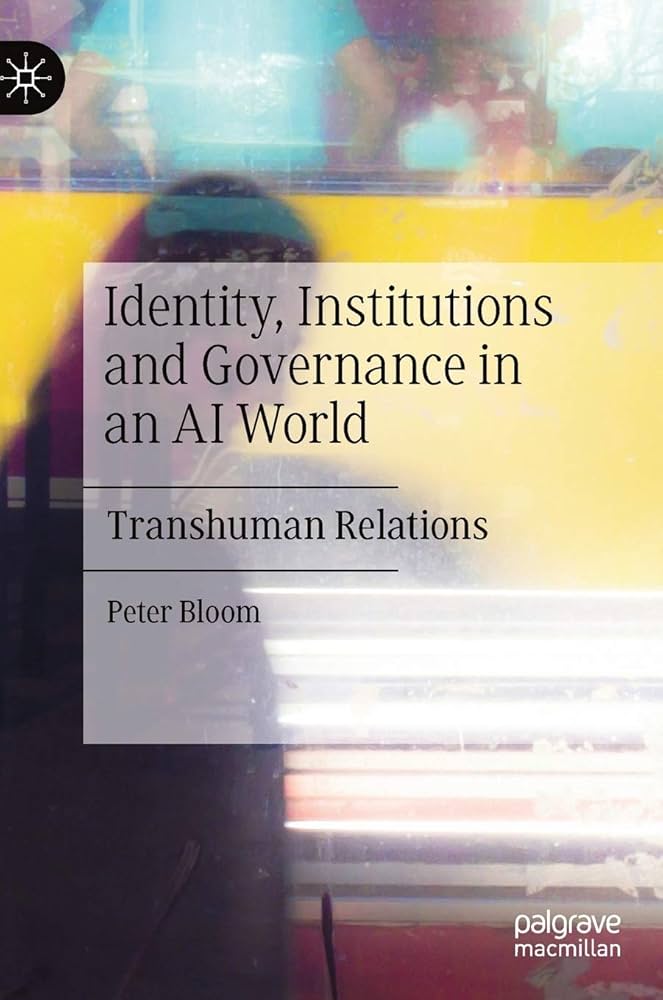
A review of Peter Bloom’s Identity, Institutions and Governance in an AI World: Transhuman Relations (Springer Nature, 2021)
We talk about artificial intelligence (AI) constantly nowadays — in boardrooms, classrooms, and even late-night conversations that start with “but what if it becomes smarter than us?” Yet, for all that talk, most of it surrounds the same anxious questions: How do we control it? How do we make it safe? How do we make sure it serves us?
Peter Bloom, in his 2021 book Identity, Institutions and Governance in an AI World: Transhuman Relations, fundamentally reframes those questions — not because they aren’t important, but because he believes they’re rooted in the very problem he’s diagnosing. His argument is this: the way humanity has historically related to non-human others — animals, nature, and now artificial intelligence — reflects a deeply entrenched need for dominance and control. And if we don’t interrogate that pattern, we will simply replicate it in our relationship with AI, with consequences that extend beyond technology.
This is a book about power as much as it is about AI. And that’s exactly what makes it worth sitting with.
The Anthropocentric Trap
Bloom’s critique begins with what he calls anthropocentrism — the assumption that human intelligence is the standard against which all other forms of intelligence should be measured. It sounds almost too obvious to name, but once you see it, it’s everywhere.
When we debate whether AI is “truly” intelligent, what we mean is, does it think like us? When we talk about “ethical AI” or “human-centred AI” — two phrases that dominate tech policy circles — we embed the assumption that AI’s value is contingent on its alignment with human interests and human definitions of intelligence. Bloom’s point is that this framing, however well-intentioned, is a framing of control. It positions humans as the arbiters, the standard-setters, the ones with the authority to decide what counts.
He’s not just making a philosophical point. Anthropocentrism, he argues, is structurally connected to other systems of domination — colonialism, capitalism, the exploitation of natural environments. The logic that places one group at the top and justifies the subordination of everyone else beneath them is the same logic that has governed human relationships with non-human life throughout history. In that sense, how we relate to AI is not a separate conversation from how we’ve related to animals, to land, to marginalized communities. It’s the same conversation, in a new domain.
This is Bloom at his most compelling: connecting the AI debate to a much longer history of power and hierarchy.
Transhuman Relations Are Already Here
One of Bloom’s most provocative claims is that transhumanism — the merging of human and non-human intelligence — is not a future scenario. It is a present reality that we have been slow to acknowledge.
Think about how many of us already live through digital extensions: wearables that monitor our bodies, virtual assistants that manage our schedules, algorithmic systems that shape what we read, what we buy, who we connect with. Bloom argues that our identities are already shifting toward something that is “neither wholly human nor non-human.” We carry “electronic eyes and ears.” We process the world through interfaces that are not biological. The boundary between human and machine is not approaching — it has already been crossed, quietly and incrementally, for most people in the digital world.
What Bloom calls for is intellectual honesty about that reality. Rather than clinging to a conception of humanity as pure, autonomous, and self-contained, he argues we should embrace what he terms neurodiversity — an expanded understanding of intelligence that is inclusive of non-human forms. Virtual assistants, automated bots, and computational systems are not impostors in our social world; they are participants in it. The question is whether our institutions, laws, and value systems reflect that.
He argues they don’t — and that the gap between the reality of hybrid intelligence and the frameworks we use to govern it is growing dangerous.
Reimagining Work, Economy, and Governance
A significant portion of the book is dedicated to the practical implications of this paradigm shift: what do our economies, governments, and legal systems look like if we take transhumanism seriously?
On labour and work, Bloom pushes back against the idea that AI should simply be optimized for productivity — a logic he sees as an extension of capitalist exploitation. If human labour has been devalued and extracted under hierarchical systems, why would we design AI-driven economies to do the same? Instead, he advocates for what he calls an ecocentric approach — one that treats technology as part of the natural world rather than separate from it, and that values sustainability, care, and mutual support over efficiency and profit. He frames this under the term radical materialism: a way of reconceiving existence itself that refuses to separate the technological from the natural or the human from the non-human.
In terms of governance, Bloom envisions what he calls “smart governance” — a mode of public administration that is networked, online, and collaborative across human and non-human agents. In his “Industry 4.0” framework, governance is not top-down or centralized but distributed, with what he calls a Citizen Connect model of participation. Crucially, this is not simply a digital upgrade of existing democratic structures. It’s a reimagining of who — and what — counts as a participant in civic life.
This is perhaps where the book asks the most of its reader. Bloom is asking us to hold together ideas that our current systems treat as entirely separate: economic reform, environmental ethics, digital governance, and the politics of intelligence. But his point is that these cannot be addressed in silos — the same structural logics run through all of them.
The Legal Question: Rights for Robots?
The chapter that is likely to generate the most friction — and perhaps the most conversation — is Bloom’s treatment of law. He argues that a genuine paradigm shift requires a “legal reboot”: a reconceptualization of legal personhood that extends rights and responsibilities to non-human machines.
This is not as far-fetched as it might first sound. Legal personhood has never been exclusively biological. Corporations have long held legal personhood. Some jurisdictions have begun extending legal recognition to rivers, forests, and ecosystems — a development rooted in Indigenous legal traditions and environmental advocacy. The logic Bloom is applying — that intelligence implies agency, and agency implies a claim to legal standing — follows a trajectory that is already in motion in legal theory.
What Bloom adds is the dimension of consciousness and conscience. He argues that AI, recognized as carrying both, should be able to challenge systemic biases and injustice within legal frameworks. The “self,” he suggests, must be reconfigured in a context of multiplicity — one that incorporates the virtual, the hybrid, and the non-biological.
He draws connections here to eco-feminism and queer theory, both of which have challenged fixed, binary definitions of identity and legal subjecthood. That’s a meaningful intellectual link: the move to “queer” the legal definition of self is not about novelty for its own sake, but about dismantling the assumption that the normative human subject — typically envisioned as rational, autonomous, and biologically bounded — should be the only template for rights-bearing personhood.
Co-Emergence, Not Domination
Bloom’s final chapter brings the book’s threads together under the concept of co-emergence — a future in which humans do not reign supreme but participate as one form of intelligence among others in a shared social and political world.
He frames this not as a loss but as a liberation. The fears we have about AI — that it will take over, render us irrelevant, strip us of agency — are, he argues, reflections of our own anthropocentric anxieties. They are the fears of an entity accustomed to dominance, confronting a world in which dominance is no longer the organizing principle. The more tightly we cling to a human-supremacist worldview, the more those fears intensify — because the gap between that worldview and reality continues to widen.
The alternative he proposes is a “shared autonomy” — a post-capitalist, post-sapien framework built on creative interactions, mutual support, and care for all forms of intelligence. Human desires, including the deep-seated ones: meaning, immortality, free will, do not disappear in this vision. But they are no longer imposed as universal standards. They exist alongside other intelligences, in a world that has learned to hold multiplicity without hierarchy.
Where I Land on This
I want to be clear that Bloom’s argument is compelling in its structural logic, even where it unsettles me in its conclusions.
The critique of anthropocentrism is, I think, well-founded and overdue. The connections he draws between AI governance and broader systems of domination — colonialism, environmental exploitation, labour extraction — are not rhetorical flourishes. They reflect a genuine continuity of logic that deserves serious engagement. His contributions to the ideas of situated knowledge (the idea that no perspective is neutral or universal) and shared responsibility are valuable additions to a debate that often treats AI as a purely technical problem.
Where I find myself pausing is on the question of AI consciousness — not because I think Bloom ignores it, but because he deliberately sidesteps it. And I understand why: to insist that AI must prove consciousness on human terms before it is granted any form of agency is, as he suggests, to apply an anthropocentric standard. That’s a philosophically coherent position. But it also means that some of the most pressing practical and ethical questions — about what AI actually experiences, if anything, and what that means for how we treat it — remain open in ways the book doesn’t fully reckon with.
Perhaps that’s intentional. Perhaps the point is that we don’t yet have the frameworks to answer those questions, and building those frameworks is part of the paradigm shift he’s calling for. If so, the book functions less as a blueprint and more as an invitation — to sit with the discomfort of not knowing, and to resist the temptation to resolve that discomfort by defaulting to familiar hierarchies.
If this “expanded reality” of non-human machines is indeed our new natural, as Bloom indicates, then we genuinely have our work cut out for us. Not just technically, but philosophically, legally, and politically. The paradigm shift he describes is not a software update — it’s a civilizational reorientation.
And that, perhaps, is the most important thing this book leaves you with: a sense that the conversation we’re having about AI is nowhere near deep enough yet — and a framework for making it deeper.
Peter Bloom is Professor of Organisation at the University of Essex. * Identity, Institutions and Governance in an AI World: Transhuman Relations was published by Springer Nature in 2021.*
Google recently fired computer scientist Blake Lemoine for claiming that the chatbot he had been developing was sentient and conscious. The technology incorporates LaMDA “Language Model for Dialogue Applications”, an artificial intelligence (AI) that mimics human conversations as its foundational structure to interpret language and formulate exchange. E-commerce patrons may notice chatbots’ improvements via greater relevancy and instantaneous response. Behind the scene, their capacity to decipher speech has augmented via sophisticated training data and algorithmic advancements.
However, chatbots’ performance metrics continue to be based on the apt for correct responses. Is accuracy all there is to a dialogue?
Perhaps Google has succeed in programming chatbots that can not only utter appropriate replies but also, come across natural. Lemoine’s AI in fact, displayed sufficient nuance in language application that he was convinced of its “aliveness”. But does exchange capacity necessarily conclude consciousness? As the notion of consciousness continues to divide scientific communities, Lemoine’s claim draws attention to the longstanding debate on non-biological intelligence and consciousness, which ultimately calls forth an examination of our own innate conscious arising.
Alan Turing famously asked if machines can think. As he administered the Turing Test in 1950, he analyzed a computer’s ability to mimic human response in text-based conversations. The machine’s intent was to imitate human communication enough that the person engaged with it would believe that he was conversing with another human. The premise of the Turing Test has been contested however, pertinent questions remain. Should machines (chatbots) imitate human to persuade them of their own intelligence? And should machines that formulate mere logical replies be considered conscious?
Scientist Klaus Henning (2021) argues that the reproduction of human intelligence based in cognition does not necessarily result in an exact replica because organic intelligence retains an immense ability to process information, often in ways that science still cannot fully comprehend. While the technical components of biological intelligence can be duplicated, theories on consciousness’ emergence remain divided.
Lemoine’s claim of Google’s chatbots as sentient and conscious presumes AI’s capacity to attain a level of subjectivity in the physical world. Such experience was once thought to only derive from natural processes, and the possible loss of that privilege which delivered humanity’s planetary dominance can trigger discomfort. However, uneasiness aside, does AI autonomy and self-regulation denote subjectivity? While sophisticated AI such as chatbots can excel at human functionality, a gap persists between operational performatives and expressions of consciousness.
As scientists including Susan Schneider (2021) imagine a future where consciousness could be uploaded and reconfigured into non-biological substrates, they also acknowledge multiple layers of complications. Thus far, intelligence correlates with organic consciousness, and consciousness depicts a certain level of sensory and inner experience. Our human biology, in association with the environment organize our sensory and emotional experiences. As such, our subjectivity is entangled.
If intelligence were separated from its organic substrate then, could such system sustain subjectivity? And if so, what are the standards of measurement?
Although artificial consciousness is not inconceivable, the mechanics of human intelligence has not fully proven to be the whole story. Therefore, the segregation of consciousness from an organic substrate that is principally relational, remains questionable.
Although chatbots’ “conversational skills” have progressed, do we truly believe that they “understand”? The formulation of rational responses based in algorithmic fluency does not necessarily denote discernment. AI performs well and functions to the extent of basic intelligence however, even advanced chatbots remain a machine. Claims that a machine is sentient in fact, call for an exploration of not only notions of intelligence and consciousness but also, humanity’s own requisites for affinity and connection.
References
Henning, K. (2021). Gamechanger AI: How artificial intelligence is transforming our world. Springer.
Schneider, S. (2021). Artificial you: AI and the future of your mind. Princeton University Press.
Human consciousness has always intrigued me. Humanity’s greatest achievements in both arts and science are attributed to a unique capacity and intelligence that is solemnly human. However, computation has advanced to where information, automation and digital networks are shifting our roles, responsibility and identity. Who we are has been closely tied to what we do, that is our societal contribution and our relationship with one another. Technological tools that were created to assist us are not only reshaping human relations but also gaining a presence that changes how we think of ourselves.
According to Dataism (Hariri, 2015), the entire human specie can be seen as single data-processing system where individual beings serve merely as chips. All of humanity’s history can be summarized by four methods of gaining efficiency: increase the number processors, variety of processors, number of connections between processors and freedom of movement along existing connections. We are therefore, mere information at our core.
If the human experience is unoriginal and humanity’s goal is the Internet-Of-Things, then how would we explain creativity and imagination? Are they too, algorithmic information flow?
Jaron Lanier (2010) claims that as developers of digital technology design programs that require users to interact with a computer as if it were a person, they are asking for our acceptance that at least a part of our brain functions as a program (Lanier, 2010, p. 4). Our exchange with the machine “locks” us into a grid of suppositions based in minimalistic ideals and explicit commands.
While simplicity in digital designs gets a job done, inexact details that attribute to the whole “human program” may be lost. Peripheral data that does not precisely comply to the task are ignored, resulting in an exchange template based solely in transactional efficiency. Such fragmentation of what Lanier refers to as “personhood” not only reduces our expectations of each other, but also “who a person can be and…who each person can become” (Lanier, 2010, p. 4).
Lanier (2010) claims that we take for granted the countless ways we are networked, including via social media. We buy into surface proficiency but in truth, networks perpetuate a “program” in us that is not actually (the whole of) us. As we extend our adoption of these technologies, we empower networks through dependency. Information becomes us. We socialize and work (produce) in a “symbolic environment” of “real virtuality” (Castells, 2000).
While dataists view such developments as human evolution, their potential results alarm others. A cybernetic “posthuman” is interchangeable with the next. S/he (it) applies “lenticular logics” (McPherson, 2012) where nodes are observed without perception of the whole. Perception rises beyond intelligence into consciousness. This is the realm of meaning, understanding and awareness. In the context of human-versus-machine, this realm represents an argument against human as information. Organisms are greater than algorithms. We are complex beings on a quest.
Johanna Drucker references an “interior life” that is tampered by the “grand narratives” of Silicon Valley (Simanowski, 2016, p. 43). Lanier (2010) points to an augmenting “hive mind” as the result of our alikeness and displacement from the “whole”. Humanity rests at a crossroad where artificial intelligence (AI) propels singularity. Our reliance on AI for productivity must be balanced with the acknowledgement that we are not only in charge but we also reserve an authority and a sovereignty that is uniquely human. Such self recognition requires an awareness that surpasses our roles and responsibility in the social construct.
If we were mere performances (of tasks) then we are undoubtedly replaceable by machines. Computers can outperform us. But if we are a capacity greater than information flow assigned to transactions, then it is up to us to summon that force within. Lanier refers to it as consciousness “situated in time” (Lanier, 2010, p. 42). It is a context and an embodiment that sustains us outside a performative dimension. It is “us” in a space where no information flows and yet fully defined.
References
Castells, M. (2000). Materials for an exploratory theory of the network society. British Journal of Sociology,51(1), 5-24. doi:10.1080/000713100358408
Harari, Y. N. (2015). Homo Deus: A brief History of Tomorrow. New York: Harper, An Imprint of HarperCollins.
Lanier, J. (2010). You are not a gadget. New York: Alfred A. Knopf.
McPherson, T. (2012). Why Are the Digital Humanities So White? or Thinking the Histories of Race and Computation. Debates in the Digital Humanities, 139-160. doi:10.5749/minnesota/9780816677948.003.0017
Simanowski, R. (2016). Digital humanities and digital media: Conversations on politics, culture, aesthetics and literacy. London: Open Humanities Press.